What Voltage LED Strip Should You Install?
To get an LED strip specification right one of the first questions you should ask is what voltage will you need? It will affect the maximum length that you can light without power loss due to voltage drop, the lumen output and the power supply that you will need.
Common options include 24V, 48V and 230V. Here we outline which one to choose for different applications and what else you need to consider for each.
24V LED Strip
24V LED strip is becoming the default option for most residential and light commercial applications. Compared to 12V options it offers more consistent brightness over longer runs so that you can light larger surfaces with a higher lumen output. It will also be more durable, last longer and generate less heat.
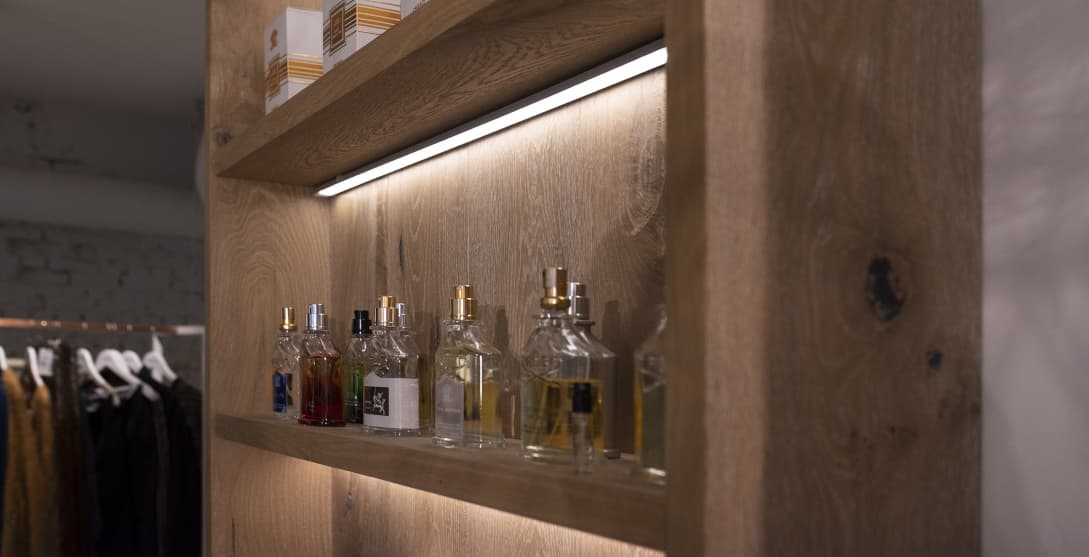
You can use it for short to medium length runs of up to 10 metres. It is a great choice for under shelf and cabinet lighting, but you can also use it for indirect lighting in a room or other areas.
As a low voltage option you can easily use it in most locations, but you will need a driver to transform the voltage to 24V, and you may need more than one driver for runs that are longer than 10 metres. And because it is becoming a default option for most professional installations there are plenty of different drivers, dimmers, and smart control options available.
Typical installation
Installation tip
If you need to use more than 10 metres, then use two separate lengths that both have their own power supply on the outside of the strip. This will make it look like a single 20 metre length once installed.

48V LED Strip
If you need to install a long continuous LED strip run of up to 20 metres using a single power supply, then 48V LED strip lighting is the best choice. You would normally specify this for commercial installations such as hospitality or retail applications.
It is still considered a low voltage option for safety. You will need a 48V driver, connectors and accessories and you will need to check that any dimmers are rated for this voltage.
Typical installation

230V Mains LED Strip
When you need to install a very long continuous LED strip of up to 50 metres, choose a 230V option such as our 70220 or 70230.
One big advantage is that you can connect this directly to the mains and do not need any drivers, making the installation simple. You can either plug it directly into a standard wall socket or hard wire it.
But because it is not low voltage, you must take extra care to ensure that the strip is intact and that there are no copper elements accessible. And like any mains installation you need to provide appropriate protection for overload and earth leakage. A 30mA RCD is essential, but we think that an RCBO is better so that if there is any earth leakage it will not cause nuisance tripping of other circuits.
Applications for 230V LED strip include hospitality spaces, hotel receptions and corridors, building facades and large gardens. Note for many of these applications you need to check that it has an IP65 rating.
Typical installation
For most professional installations 24V LED strip is an excellent choice. It is more versatile than 12V offering a reasonable run length for residential and some commercial installations. If you do need longer runs with fewer power inputs, which you often find in commercial applications, then 48V LED strip is a sound low voltage option. For very long, continuous runs of up to 50 metres, you will need to use 230V LED strip. The latter will need earth leakage and overcurrent protection.
What voltage LED strip you use is just one factor to consider in a specification. You also need to think about what illumination levels your customer will need, the colour temperature of the light, where it is being used, which profile to use, its IP rating and what accessories and control to provide.
Read our other LED strip lighting blog posts to find out more. “How to specify LED Strip for residential primary lighting”, “Using LED Strip in a layered lighting scheme”, and “How to specify and install outdoor LED strip lighting.”
Articles you may also like
These are articles we recommend that you also mind find interesting

Be the first to know the latest updates
Subscribe to our newsletter!
