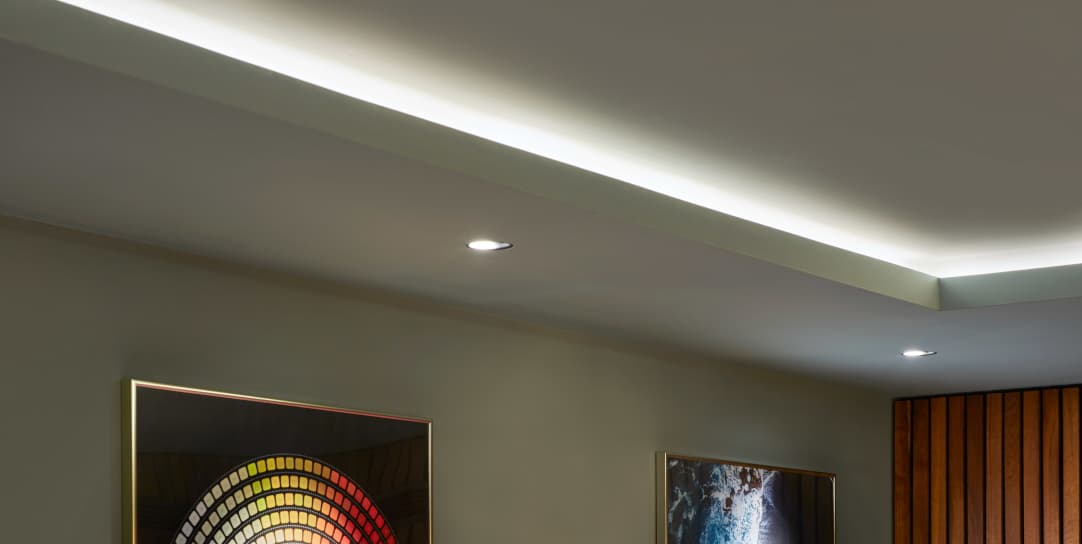
How to specify LED Strip for residential primary lighting
If you get it right LED strip lighting can create an excellent source of primary lighting in the home that will delight your customer. It is clean and subtle, providing even and glare free lighting for a relaxed atmosphere. Here’s what you need to know for a successful specification and installation.
Enough illumination
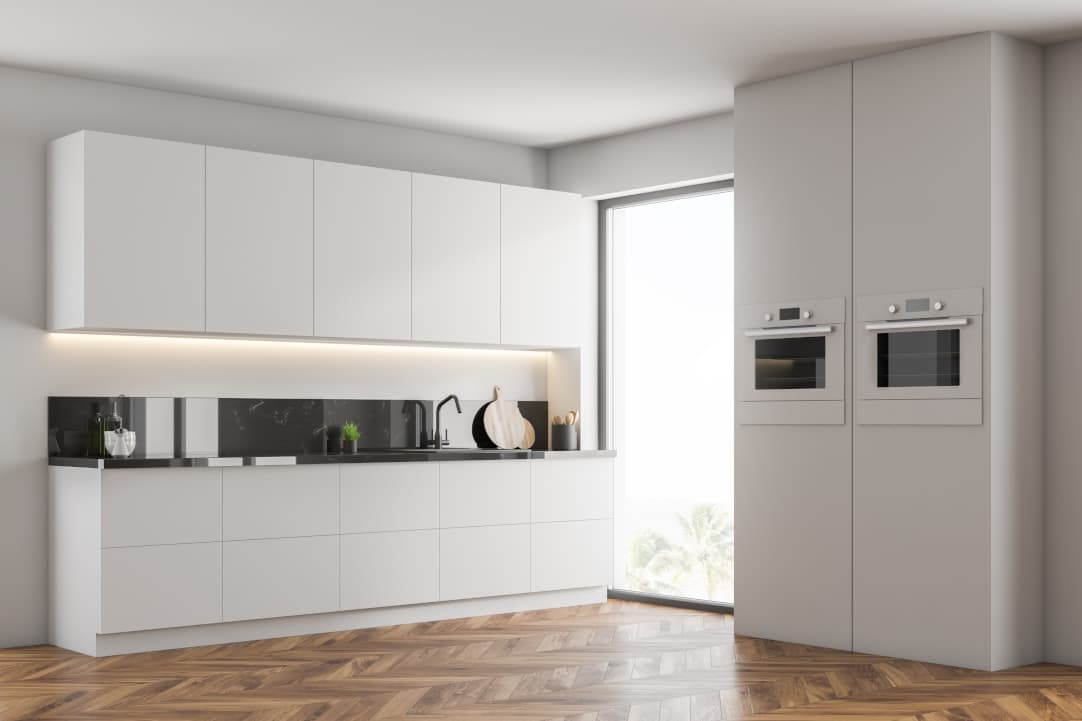
A good LED strip lighting installation produces a diffuse even light by reflecting it back off a surface, in this case the ceiling. While this can make it a great source of ambient lighting, you must make sure that you provide enough illumination.
The exact output needed will vary according to how people use a space so a task orientated room like a kitchen will need more light than the living room or bedroom where the emphasis is on relaxation. But whatever room it is, you will need to install LED strip that has a much greater lumens output than what you would use for accent lighting such as under cabinets or shelving.
You also need to factor in the colour of the ceiling, a white or light colour is best for reflectance; and its height, the higher the ceiling the more powerful the LED strip that you will need. And if you are installing it in rooms where people need to complete tasks, such as the kitchen or a meeting room, you would be wise to supplement it with additional focussed lights onto the work areas, such as downlights or spots.
You can of course work out what illuminance you need on a room-by-room basis based on the lux level you need and the size of the room. Multiply these together and you get a total lumen output but remember that the light reflects off the ceiling and/or wall to create that soft diffused light that your customer wants, so there will be some loss that you need to allow for.
Specifying the right LED strip
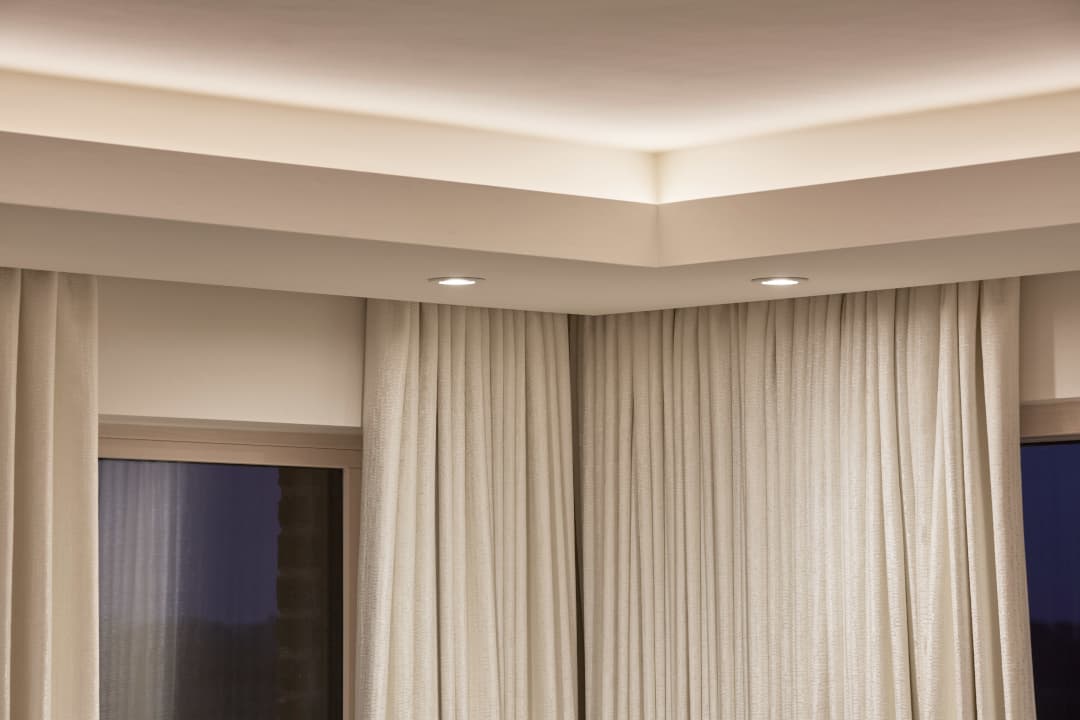
If LED strip is the only primary lighting in a room, then you should not go below a rating of 8W/m. But check how many lumens per Watt it produces over a metre – the higher the number the more energy efficient the LED strip is. And if the length of LED strip is longer than 5 metres then make sure that you use a current regulated option.
In general, more task orientated rooms such as the kitchen need a higher level of ambient light while others like the living room and bedroom are spaces where people want to relax so a lower illumination may be better.
For ambient lighting we recommend something between 8-11W/m such as our 48092 strips rated at 11W/m which will produce 1620 lumens or more per metre. This should be fine for most applications.
But, if your customer needs brighter general lighting you need to specify a higher output like our 80300 rated at 14W/m with an output of up to 1960 lumens and for even more light, perhaps to account for a higher ceiling, then consider something like our 80160 with a power output of 15W/m producing up to 2752 lumens per metre.
Remember if you specify a driver that allows dimming, then it is better to overspecify the illumination level so that your customer can control what level and atmosphere they want to create in the room.
Correlated colour temperature with LED strip lighting
In addition to the illumination levels you want for a room, you should also think about the colour temperature of the lighting to create the atmosphere that your customer wants.
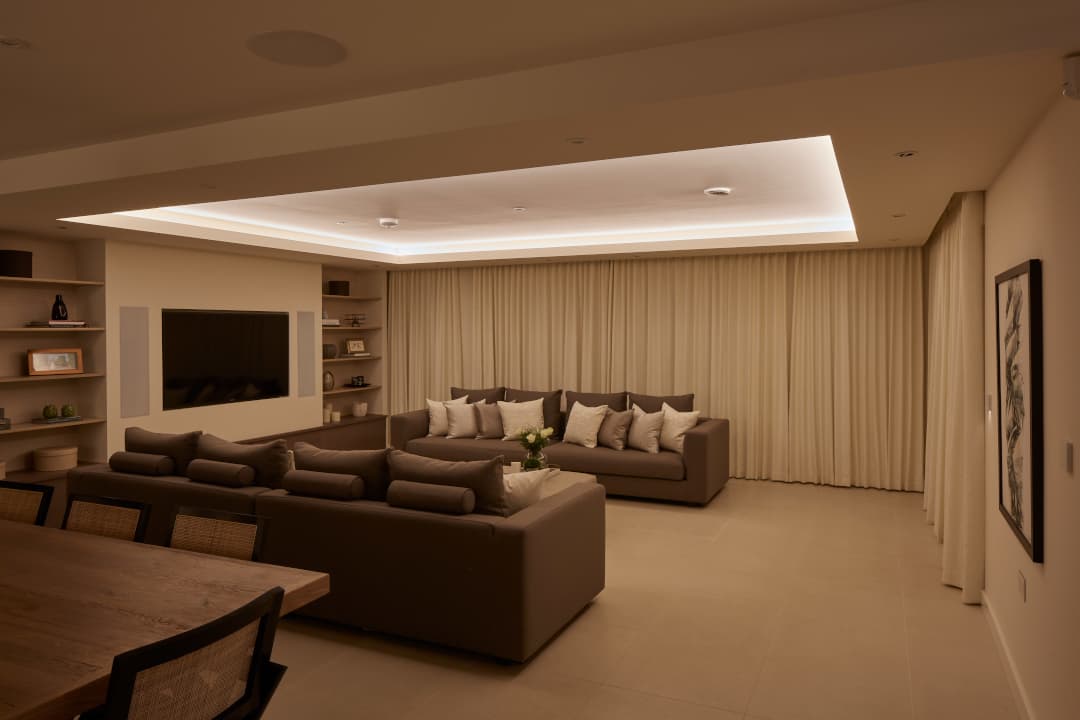
For task orientated areas such as a home office or an office meeting room a cooler light of 4000K helps focus and concentration. In rooms where people want to relax then a warmer light of 3000K or even 2700K is better.
And decoration will play a role in this decision. While LED strip lighting is better when used against a light-coloured ceiling to maximise reflectance, if the walls and furnishing use warmer tones such as reds, oranges and yellows or wood, then a lower colour temperature will help make it glow. Conversely if the room has cool colours such as blues, greens or white then higher colour temperature lighting will accentuate this and make it pop.
IP rating for wet areas
If you need to install LED strip outside or in rooms where moisture is a factor such as a bathroom or toilet, then check the IP rating of the LED strip light.
For a general room such as a living room or bedroom an IP20 rating is fine. If it is being installed in a wet environment, then you should specify at least IP65 rated LED strip such as our 50051 or 80310 for general lighting. You can install both of these outside or in bathrooms and toilets.
Getting the right profile
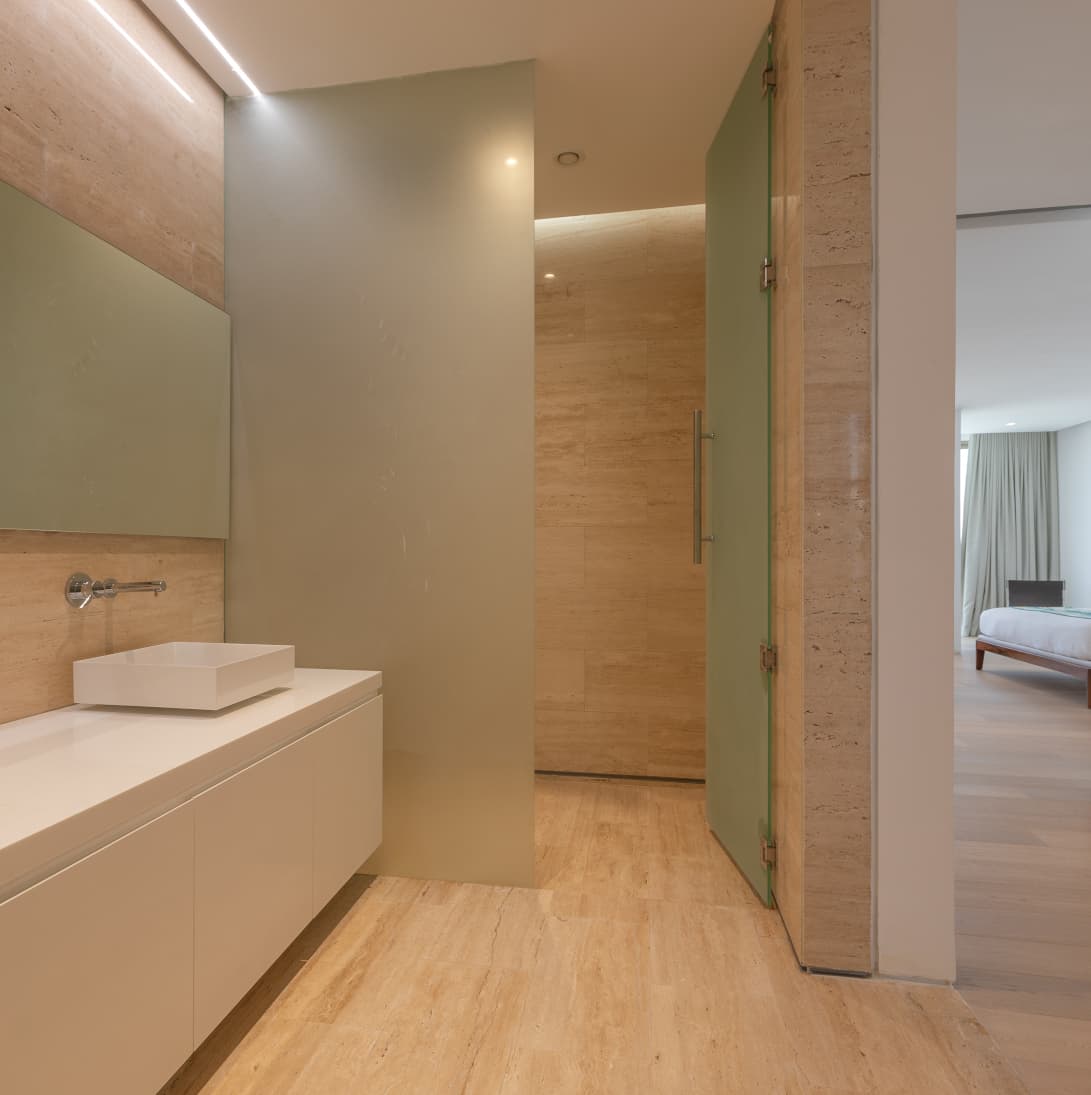
LED strip lighting has a certain understated style and to achieve this subtle look you need to choose the right profile to leave your customer with a clean and flat surface.
A recessed profile will blend seamlessly into the ceiling or wall to create a flat surface, or you can use a surface mount in the ceiling void. Other options include a plaster in profile which you can fix in place before a ceiling is plastered.
Another simple solution, especially for retrofits is a cove pack. Mounted high on the wall this directs light from the LED strip onto the ceiling to create a striking wash of light up the wall before it reflects off the ceiling. Our cove packs have an upper channel for the LED strip lighting and a lower concealed channel that directs all the cabling. And you can paint it so that it matches the room’s decoration.
Selecting the right driver and accessories
LED lighting needs a driver to change the alternating current from the mains to a low voltage direct current of 24V and to smooth out any power surges to ensure that the LEDs are not damaged and maintain a consistent brightness.
The driver you need will depend on the output of the LED strip lighting you specify, whether your customer wants dimming and, if the lighting is being used outside or another wet area, its IP rating. The LED strip lighting manufacturer should be able to advise.
You also need to plan where you will put the driver. It should be out of sight but accessible in case it needs maintenance or replacing. Does it fit within the ceiling void where you can easily reach it, or can you put it on top of a cabinet?
You will also need LED strip connectors. There are several types that connect strips together, go round corners and awkward angles, end a strip and connect the strip to a power supply.
Which LED strip to use
When it comes to specification you will see lots of different types of LED strip lighting.
For primary lighting you would normally specify flexible tape. There are two versions. A constant voltage strip is fine for lengths of up to 5 metres. But for ambient or general lighting we would recommend specifying current regulated strip. This is higher quality option with CRI 90 chips and is great for runs of up to 20 metres.
Modern LED lighting technology offers your customer far more options to get creative with their lighting. LED strip lighting is a great example. Most people know how good it is for accent lighting under cabinets and shelving, but its flexibility means that many are using it as their primary source of lighting for some rooms make sure that you profit from this trend.
Articles you may also like
These are articles we recommend that you also mind find interesting
Be the first to know the latest updates
Subscribe to our newsletter!
